
Where Brown County Arrest News Appears
Start with the county itself. Brown County posts no online jail roster. There is no booking feed and no set schedule for releasing booking photos. So custody questions go to the Brown County Sheriff's Department, the office to ask for a booking sheet or photograph. When a case draws attention, the sheriff may issue a statement or a social media post. That is selective news, not a full arrest log. A name with no photo does not mean no booking record exists.
The Brown County Democrat arrest archive is the best dedicated local source around. Its old weekly "Fine print" posts were plain text. Entries carried a booking date and time, the person's age and hometown, a preliminary charge, and the arresting officer. Release details appeared sometimes. The last weekly entry dates to November 2021. Treat the category as an archive, not a current feed. Newer blotter stories tell incidents in narrative form. They often use file photos or story images, not a mugshot gallery.
Regional outlets pick up selected cases too. WRTV's crime desk covers major Brown County events, not every booking. Indiana Public Media is event-driven. It draws on probable-cause affidavits, court hearings, and jail information. Neither replaces a sheriff confirmation or a court search. No current, comprehensive gallery of Nashville arrest photos checks out.
Brown County News Source Comparison
Each source answers a different question. Official contacts and court records carry the most weight. Local journalism adds context that raw records lack. Commercial archives can point you toward a possible lead, though their entries may be stale, incomplete, or copied from another site.
| Outlet | Coverage | Photos? | Where |
|---|---|---|---|
| Brown County Sheriff's Department | Custody confirmation, records requests, selected releases | No public photo feed | Official sheriff page |
| Brown County Democrat | Historical weekly bookings and later police narratives | Old lists were text-only | Arrests archive |
| WRTV | Selected major regional cases | Story-dependent; researched example used generic art | Crime desk |
| Indiana Public Media | Selected regional cases and court context | Story-dependent; researched example used file art | News desk |
| Busted Newspaper | Unofficial multi-year county archive | Yes | Brown County section |
| RecentlyBooked | Unofficial rolling 30-day view | Yes | Brown County page |
| Arrests.org | Unofficial date and pagination view | Yes | County filter |
| Mugshots.zone | Unofficial dated cards; variants may occur | Yes | Brown County archive |
| Mugshots.com | Unofficial, largely historical county archive | Yes | County archive |
The five commercial sources sit last for a reason. None is an official custody or court authority. Their time windows vary. That means their totals cannot be stacked up as arrest statistics. A card can linger after release. A missing card may just mean the collection was delayed or never finished. And locality tags like Nashville or Beanblossom are search labels. They are not proof that a town police department made the arrest.
How Brown County Photos Reach News
How does a newsroom get a photograph? Usually through an agency release or a public-records request. Brown County publishes no written booking-photo policy. No open photo feed exists either. Indiana's Access to Public Records Act, IC 5-14-3, governs records held by public agencies, subject to lawful exceptions. No Indiana statute sets a special statewide mugshot-publication rule. So a missing online image does not mean every photograph is confidential.
To trace a record, start with the person and the approximate booking date. Then ask the sheriff for the booking sheet, the photograph, and the release entry. The department works through its main contact. It has no separate records unit, no request form, no fee schedule, and no posted photo policy. Juvenile, sealed, expunged, or otherwise protected material may stay closed. An agency can also release selected case information without running a full public booking archive.
Trace Brown County News to Records
A publication date is only the first clue. Someone just booked may still be sitting in the Brown County Jail. A released person is out of custody, even though the booking sheet, the news post, or the court case lives on. A person later sentenced to state custody moves into the Indiana Department of Correction system, not the county jail. Keep those stages separate by following this sequence:
- Read the story closely. Note the full name, incident or booking date, arresting agency, and whether the report describes an arrest, a filed charge, or a court result.
- Confirm present custody. Call the Brown County Sheriff's Department at 812-988-6655. Brown County has no verified public online roster or same-day booking feed.
- Request the booking record. Ask the sheriff for the booking sheet, photograph, and release entry when the online sources do not answer the question. The county-wide booking and feed paths are detailed on the Brown County busted mugshots search.
- Search the court case. Use Indiana MyCase by party name or cause number, select Brown County or Brown Circuit Court, and compare dates and identifiers.
- Read through disposition. Review the chronological case summary for amended or dismissed counts, hearings, pleas, trial events, orders, and final disposition.
MyCase covers non-confidential Odyssey cases. Some material stays off the site. Protected documents, juvenile matters, sealed files, and granted expungements may not show up online. Need help routing a court-record question? Call the Brown Circuit Court Clerk at 812-988-5510. Keep in mind that MyCase is not a live jail roster. "Disposition" simply means the court's final outcome on a charge or case.
Brown County Weekly Blotter Archive
The Democrat's old weekly format shows how booking news once worked, before photo galleries took over. Posts covered a defined date window with text fields. These included booking time, preliminary charge, officer, and sometimes release method or time. They also noted that listed charges were not findings of guilt. That structure gave readers real context without turning people into a gallery.
The dedicated archive seems to stop after November 2021. Calling it "weekly" today would mislead. It cannot tell you who is in jail now. Later "police blotter" stories are narrative reports on selected incidents. They sometimes include officer or report details, but never exhaustive jail lists. For agency and booking routes in the county seat, see the Nashville busted mugshots page.
Brown County Booking Versus Court News
Any arrest story in the Democrat used to sit in one of two buckets, and the split still helps readers today. One bucket covers jail bookings. That is the jail's intake process, plain and simple. The other covers criminal court, where the prosecutor files charges and the docket tracks everything that follows. The two rarely match word for word, since a preliminary charge recorded at booking may look different once the prosecutor formally files a case.
MyCase is the tool that bridges the gap. Search by cause number, party name, or attorney. A name search even offers a sounds-like option, with filters for court, case status, and filing date. Match more than a name, though, before assuming a result belongs to the same person. The chronological case summary shows filed charges, hearings, motions, orders, plea or trial events, and the final disposition, which is context a booking photo simply cannot convey.
Brown County News Naming Standards
Newsrooms set their own bar for naming suspects. It varies. WRTV, in one Brown County State Park story, said it holds off on a name until formal charges are filed. That choice binds no one else. The sheriff, a rival outlet, or a mugshot archive can publish the same name on a different timetable. WRTV leaned on a sheriff social post for that report. It ran generic handcuff art instead of a booking photograph.
Indiana Public Media took another route with its Nashville-area reporting. It pulled from a probable-cause affidavit, a jail booking, and a court hearing to build the story. A file siren photo filled the visual slot. So "mugshots in the news" rarely means an actual mugshot anymore. Solid reporting now leans on court filings and agency statements, with neutral stock images filling the gap. Probable cause is what supports an arrest.
Brown County Mugshot Archive Limits
Commercial archives vary widely. RecentlyBooked keeps a rolling 30-day window refreshed several times a day. Busted Newspaper reaches back years. Arrests.org sorts dated entries into paginated groups, while Mugshots.zone posts event-driven dated cards that can include duplicates or name variants. Mugshots.com looks dated and thin for Brown County. A name can show up in one archive and vanish from another simply because their windows differ.
One successful capture came from the unofficial Mugshots.com Brown County archive:
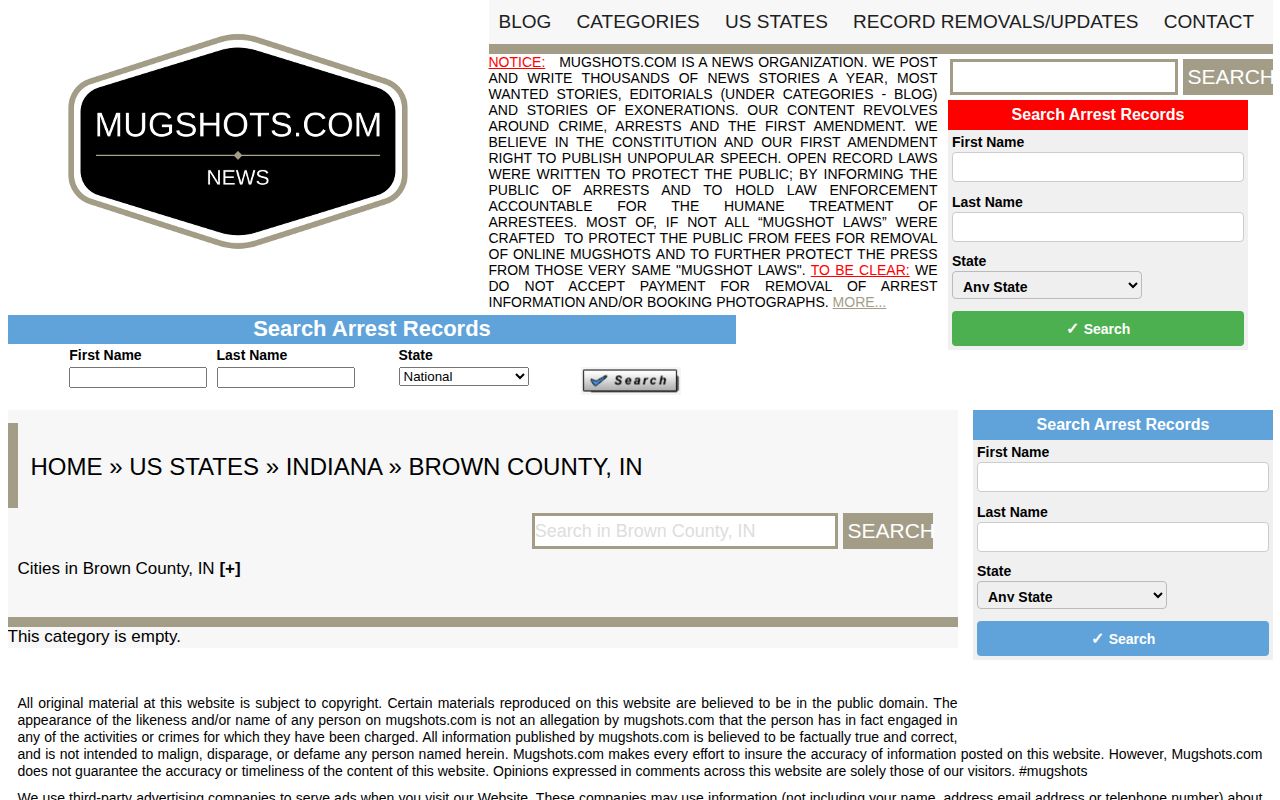
The screenshot shows the kind of commercial archive a reader might stumble into. It is not a live custody roster. Verify any booking through the sheriff. Then check the case outcome in MyCase. Skip the numbers entirely. Views, card counts, and archive totals can be skewed by duplicates, deleted entries, repeat bookings, and mismatched collection windows, so they say nothing real about crime trends.
Public Record Search
Sponsored Results